|
In the accelerated projection, residential gas consumption could be 30 percent higher in 2020. Residential natural gas consumption peaked in 1996 at 5.2 quads but fell to 4.5 quads in 1998 due to unusually mild weather. The accelerated scenario projects residential consumption of 7.4 quads by 2020, up 30 percent from the 5.7 quads forecast under the current projection. The accelerated projection reflects continued high penetration by gas in new homes and conversions from other fuels to gas in existing homes. Roughly 200,000 heating customers per year have converted to gas over the past decade, and there is significant conversion potential in other non-heating uses where gas market share is lower such as in cooking and clothes drying. The accelerated projection also includes growth in nontraditional gas markets, including gas cooling and distributed generation.
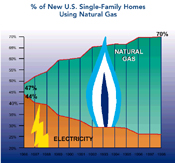
More than 56 million homes, or 55 percent of all U.S. households, use natural gas. Of the roughly 102 million households in the United States, more than 56 million are served with natural gas. Gas is highly valued by consumers, and, in fact, 70 percent of all single-family homes completed in the United States in 1998 use natural gas.
Nationwide, 52 percent of the market is served by gas, but there is significant regional variation. Gas holds 47 percent of the market in the Northeast, 38 percent in the South, 73 percent in the Midwest and 58 percent in the West.
In addition to space heating, gas is used primarily for water heating, cooking and clothes drying. Gas also is being used in a number of less traditional applications as discussed below. Consumers prefer gas because it is a high quality yet economical energy source. Gas provides warmer air for heating than heat pumps, more precise temperature control for cooking than electricity and quicker recovery time for water heating than electricity yet it is the most economical source of residential energy, according to the Department of Energy.
Residential gas use is becoming increasingly energy efficient. Approximately 90 percent of the gas energy produced reaches the ultimate consumer in a usable form. In addition, homes have become better insulated and more tightly designed, and gas appliances have become increasingly efficient. Thus, energy resource requirements, customer bills and environmental impacts are reduced. The average residential customer consumes 16 percent less gas today than in 1980, with 53 percent of this decline attributable to more efficient gas appliances and one-third due to better-constructed homes.
Homes using natural gas produce an estimated 60 percent less greenhouse gases than
 electric homes and 42 percent less than oil homes. Given the clean-burning characteristics of natural gas and the high level of total energy efficiency when compared with the major competing fuels, the potential for environmental benefits is clear. In general, natural gas burns more cleanly than oil, and it also is preferable to electricity due to the lower efficiency of the electricity system and the emissions generated at electricity power plants. As an example, compare the carbon dioxide emissions attributable to the natural gas-fueled space- and water-heating, cooking and clothes-drying appliances of a typical new 1,500-square-foot home with those of a similar-sized, new oil or electric home. Carbon dioxide is the principal greenhouse gas, and anticipated annual emissions in this example are 7,400 pounds per year from the gas home versus 13,100 pounds from the oil home and 19,700 from the electric home. (This comparison assumes that electricity is generated by today's fuel mix of coal, natural gas and oil.)
Significant opportunities exist for the conversion of existing customers to gas. Generally, the market share for gas water heaters is very close to the market share for heating on a regional basis. For example, 73 percent of the homes in the Midwest use gas for space heating, and 65 percent use gas to heat water. Similarly, 38 percent of the homes in the South have gas space heating, and 34 percent have gas water heating. However, gas ranges have a 39 percent market share in the Midwest and a 23 percent share in the South, and the respective market shares for clothes dryers drops to 32 and 9 percent, respectively, in these regions. Clearly, there is a significant opportunity to increase the number of tasks fueled by natural gas.
New residential gas uses range from fireplaces and air conditioners to microturbines and fuel cells. Residential customers are using gas in a number of new and innovative ways, and technologies currently being demonstrated could change the nature of the market.
Gas fireplaces have become a particularly strong
 new market due to economical operation and ease of use as well as environmental considerations. The typical gas fireplace is far cleaner than its wood counterparts, eliminating or making major reductions in a variety of pollutants, including carbon dioxide, nitrogen oxides, carbon monoxide and soot. In fact, wood fireplaces are banned or restricted in a number of areas, including Denver, Portland, Phoenix and Los Angeles due to environmental concerns. Currently, gas fireplaces account for 125 trillion Btu annually. The sales of natural gas and propane fireplaces now far exceed sales of wood-burning units.
Gas air conditioners have been available for decades, but they have not fully met customer needs in terms of performance, economics and reliability. That is now changing. The residential gas absorption units now on the market use 30 percent less energy than their predecessors, are expected to last 20 years with a low level of maintenance, run quietly and produce no polluting CFCs or HCFCs. Gas air conditioning has great potential, particularly in the West and South.
Back to Table of Contents
|
Fuel Cells Come Home
Gas-based distributed generation has the potential to radically alter the residential market. Rather than purchasing electricity from distant generating plants, various modes of distributed generation offer residential customers the option of using natural gas to produce electricity at their home. This can be done through very small gas turbines, or "microturbines." It also can be done through fuel cells.
A fuel cell is a self-contained unit that converts natural gas to electricity and heat through a chemical reaction (as opposed to a combustion process). Fuel cells preclude the need to construct costly and disruptive transmission lines, and they protect consumers from power outages.
Fuel cells are energy efficient (40-60 percent), and they can reduce a number of pollutants, including carbon dioxide (by 70 percent relative to coal-based electricity) and nitrogen oxides (by 85 percent relative to the ultra-tight Los Angeles standards) — with no discharge. A limited number of residential fuel cells are in use today, including the 7 kW residential PEM fuel cell installed by Plug Power in the house pictured below, with current installed costs ranging from $7,000 to $10,000. Mass production could cut the cost in half within the timeframe of this study.

In July 1998, a single-family home in Latham, N.Y., was disconnected from its local electric utility and powered up with PLug Power's 7 kW residential PEM fuel cell — the first house ever to do so. In August 1999, the system was converted to use the home's incoming natural gas line as the fuel supply.
|