|
Using natural gas in place of other fuels can help ease a number of environmental concerns — greenhouse gas emissions, acid rain, smog, solid waste and water pollution. When natural gas is burned, it produces virtually no emissions of sulfur dioxide or particulate matter and far lower levels of "greenhouse" gases and nitrogen oxides than such competing sources of energy as oil and coal. In addition, unlike the oil, coal and nuclear processes, the natural gas process produces virtually no solid waste and has much less impact on water quality.
The inherent cleanliness of natural gas when compared with those other fuels, coupled with the high efficiency of natural gas equipment, means that substituting gas for the other fuels can help reduce the emission of the air pollutants that produce smog and acid rain and that could exacerbate the "greenhouse" effect.

The natural gas system is extremely efficient as are most types of appliances and equiptment that operate on natural gas. Energy efficiency refers to the energy input per unit of useful energy output. In other words, energy efficiency measures how much energy is used or lost in providing such things as hot water, steam, warm or cool air. The higher the energy efficiency, the greater the conservation of energy and the lower the environmental impacts.
When the entire cycle of producing, processing, transporting and using energy is considered, natural gas is delivered to the consumer with a "total energy efficiency" of about 90 percent, compared with about 27 percent for electricity. Moreover, gas appliances and equipment are extremely efficient as evidenced by the fact that the residential use of gas per customer is about 16 percent less today than it was in 1980.
Natural gas is the most economical energy choice. Natural gas is usually the most economical form of energy available regardless of which competing fuel it is measured against, the application involved or the geographical location of the consumer.
For instance, using the 1999 average national energy prices published by the Department of Energy, heating an average-size house in a moderate climate costs 5 percent less to heat with gas than with heating oil and 33 percent less than with an electric heat pump. Similarly, using gas to heat household water is about half as expensive as using electricity. Even with the aggressive demand levels of the accelerated projection, gas will remain price-competitive.
Natural gas is a highly reliable North American energy source. Approximately 85 percent of the natural gas consumed in the United States is produced domestically from the nation's extensive gas resource base. Nearly all of the remaining 15 percent is produced in North America, primarily in Canada. In comparison, close to 60 percent of the oil used in the United States is imported from foreign countries, some of which are politically unstable.
Furthermore, natural gas is a reliable source of fuel not only because most of the supply is domestic, but also because the pipeline delivery system is underground and protected from weather-related disruptions.
This reliability is one of the reasons businesses that cannot afford power disruptions find gas-fired distributed electricity generation so attractive (see "Gas Puts Electricity on the Doorstep," page 25). For instance, McDonald's and other food chains are testing gas-based distributed generation because they cannot afford power outages that could destroy their food products.
Natural gas technologies can contribute to the United States' foreign trade offerings. An expanding domestic natural gas industry offers worldwide trade opportunities. The United States leads the world in terms of its natural gas infrastructure, and U.S. companies are furnishing equipment and expertise to countries in Central America, South America, Europe and the Far East that are just beginning to develop natural gas systems. In addition, a strong global market exists for gas-related products such as high-efficiency gas turbines.
The domestic natural gas industry employs
 hundreds of thousands of workers and helps fuel the economy. Besides providing one of the fuels that drive economic activity, the U.S. natural gas utility industry employs about 150,000 people. Roughly the same number of people currently work for oil and gas exploration and production companies.
Gas utilities have strong ties to the communities they serve, purchasing goods and services in addition to providing jobs. According to the Department of Commerce's Bureau of Economic Analysis, every $1 million of revenue generated by gas utilities increases national economic output by $2.66 million, employee earnings by $450,000 and employment by 14 workers.
Back to Table of Contents
|
TEE: A Key to Sound Energy Decisions
The concept of energy efficiency often is applied only to the efficiency of a specific product, such as a boiler, furnace or turbine.
A truer measurement of energy efficiency takes into account all of the energy used or lost in the production, processing and delivery steps involved in supplying energy to run factories, businesses, homes and vehicles, plus the efficiency of the energy-using product itself. Measuring the efficiency of the entire energy cycle from production through actual use is called "total energy efficiency," or TEE.
The difference TEE makes can be illustrated by a household water heater. An electric water heater may be considered "90 percent energy efficient." In reality, however, only about 27 percent of the energy contained in the coal, oil, natural gas or uranium used to generate the electricity that runs the water heater actually reaches the equipment in a useful form. In other words, about 73 percent of the energy is "lost," mostly in the process of making the electricity. On the other hand, using the TEE measure, natural gas is delivered to consumers with a total energy efficiency of roughly 90 percent.
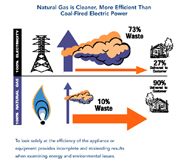
To look solely at the efficiency of the appliance or equipment provides incomplete and misleading results when examining energy and environmental issues.
|